Wednesday, May 21, 2014

May You Dance Freely: A medical student's reflection on death and dying

One of the greatest lessons to learn in the 3rd year of medical school, is how to process death. Walking patients through the process of dying is both an extraordinary burden, and an extraordinary gift. This blog post is longer than my typical, and is a reflection on my first experience with death in medical school, as experienced last fall.  Permission was obtained from the patient's family to share their story, and names and other identifiers of the patient, family, and physicians involved have all been changed.  If you have any concerns, thoughts, or questions about the contents of this reflection, as always, please be in touch!


**************


It was a cool fall evening in Wyoming. An early blizzard had blown in a couple nights before, and the snow was melting away from branches to reveal newly uncovered fall leaves gently blowing in the breeze.  Having just finished a workout at the local YMCA, I retrieved my phone from my locker and saw a missed call from the local area code.  I quickly dialed up my voicemail, fearful of what I had missed, and sat listening.

“Hi Analiesse, this is Dr. Koreis. There is a patient in the ICU I would like you to see.  Her name is Miriam Shank.  We were called as a surgical consult.  I don’t believe that surgery is appropriate for her at this time, but I would like you to see her, and give me your thoughts.  But, Analiesse, just as a fore warning, I don’t believe she is going to make it through the night.  So, go when you have time, but guard your heart, and probably head over before the evening is over.”

I nodded slowly, trying to understand the sentiment and underlying meaning of the message.  I had seen death in different contexts.  I had seen bodies at funerals, neatly dressed in pressed suits or dresses, lying peacefully in a casket.  I had lost a grandfather I was particularly close to, and spent a significant amount of time with him not long before his passing.  And I walked the streets of Port au Prince shortly after the January 2010 earthquake, when the sight of bodies was not uncommon, and the stench of decaying death clung to my skin and hair for weeks, and remained seared in my memory for months.  But, while death is a common understanding and topic of medicine, and I had cared for patients who were understood to be on their way to passing, never had I been asked to spend time with someone actively dying.

I took my time changing back into clothes appropriate for the hospital, and allowed my mind to wander.  What would I see when I went to visit?  What would I say to the family, or to the patient?  Would the patient be able to communicate?  Would there be crying?   How does Dr. Koreis know that she is going to pass away soon, and why would he give up?  Why could we not do surgery? 

I made my way to the ICU, and after noting that she was there alone, logged into the electronic patient record to determine for myself more of what was going on.  She was an 82 year old woman who had been brought into the emergency room that morning from a local assisted living home, with newly onset confusion, fever, and leg pain.  The notes in the chart made it difficult to determine the degree of confusion and pain with which she presented, but as I reviewed the patient’s vital signs and lab values, it was clear that she was quite ill.  The surgeon’s note from his consult visit had not yet been included in the chart, so I decided to see the patient myself.  I checked in with the nursing staff, and was informed that I would need to put gown and gloves on as patient had tested MRSA (a contagious, and at times very dangerous, bacteria often found in skin wounds) positive, and that I should stick my head out of the room if I needed assistance of any kind.

I donned gown and gloves as instructed, and timidly made my way into the room.  The patient was a moderately set woman, with curly gray hair mildly matted where her head met the pillow.  She lay covered in a sheet, arms bruised where I presumed IVs had been attempted or blood drawn, and she breathed heavily through parted and chaffed lips, with an occasional moan escaping those lips.  I stood staring at the telemetry monitor for quite some time, before putting a stethoscope gently to her chest and listening to her rapidly beating heart.  I then placed the stethoscope at the sides of her chest, and listened intently for lung sounds, for which I was met by raspy crackles.  I placed the stethoscope back around my neck, and watched quietly as she tossed around a small amount.  She furrowed her brow and moaned some more.

Having watched me for a few minutes, the hospitalist physician gently knocked on the door, and joined me in the room.  “Analiesse, good evening.  Dr. Koreis told me you might be by this evening.”

“Hi, Dr. Ashby.  Can you tell me a little bit about what’s going on with Ms. Shank?”

“Of course.  Ms. Shank is an 82 year old woman with long standing diabetes and heart disease, who has been doing fairly well and living mostly independently, but was found in her apartment laying in her bed this afternoon, moaning, and not able to make much sense.  She was brought into the emergency room where she was noted to have a temperature of 103 degrees Fahrenheit, tachycardia (a rapid heartbeat), hypotension (low blood pressure), a severely infected sore on her foot, and cellulitis (red, infected skin) extending from the sore clear to her upper thigh.  There in the emergency room, they immediately started an IV, and drew labs.  After review of the labs, it was determined that Ms. Shank has severe sepsis, and Dr. Koreis was called for a surgical consult.  Upon seeing the patient, Dr. Koreis felt that the patient was suffering from necrotizing fasciitis, likely influenced by the patient’s diabetes.  He was faced with the difficult decision: either rush the patient to the operating room and amputate the entirety of the patient’s leg with only a small chance of saving her life, or treat with the patient’s comfort in mind, and the understanding that she was likely to die no matter any attempt otherwise.  After Dr. Koreis learned of Ms. Shank’s heart condition, he did not feel that she could survive such a significant surgery, and after consulting with another surgeon, decided to not attempt surgery and treat for comfort.” 

I stood there, nodding slowly, watching her heart rhythm trace across the monitor.

“Would you like to see her foot?”

I nodded.  “Yes, please.”

Dr. Ashby moved to the edge of the bed, and gently pulled the sheet back from the patient’s foot, which lay propped on a pillow and wrapped in a blue absorptive pad.  As he gently unwrapped the foot, the smell of decaying flesh surrounded us, and the patient began to moan and toss about more.  When the foot had been revealed, a raw and fleshy wound consumed half the foot, and the remainder of the foot appeared swollen and deeply red, with areas of darkening. The red extended up the leg, and just past the patient’s knee.

“Ms. Shank, are you in pain?”  I asked loudly.  The patient moaned incomprehensibly again.  “Dr. Ashby, I noticed that we are giving her IV antibiotics, but I don’t see that we are giving her any pain medication.”

Dr. Ashby nodded thoughtfully.  “We started the IV antibiotics in the emergency room, and have not discontinued them as I am waiting until the family arrives, is able to understand the situation, and gives consent to discontinue all treatment outside of comfort care.  But regarding pain management, you make a good point.  It is difficult to know how much pain she is in, given that she cannot communicate with us, but it would be fair to say that she may have a good amount of pain.  Little harm can be had by treating her pain, so I will go ahead and order something for that.”

“You mentioned her family.  Are they on their way?”

“Her closest contact lives in Idaho, and is on their way in, but last I heard got stuck along the way due to snow from the storm.”

I nodded an understanding.

“Any questions I can answer for you?”

“Not right now, I don’t think. Thank you, though. Do you mind if I stay in the room with the patient for a little while?”

“Not at all!  Please do.”

Dr. Ashby left the room, and after re-wrapping the patient’s foot, I moved to the head of the bed.  Noting her dried and ulcerating lips, I wet a sponge stick beside the bed, and gently wet her lips.  And then feeling the cool skin of her arms, I tried to communicate with Ms. Shank once again.  “Ms. Shank, are you cold?”  With more moaning in response, I retrieved a blanket from the corner of the room, and tucked her in. 

I stared at the telemetry monitor a while longer, listening to her moans, and then began to talk.  At first, I felt silly.  This woman did not know me, was about to die, probably did not understand what I was saying, but yet I was going to talk to her.  “I’m so sorry,” I cooed, “I know this isn’t fun.  I know.”  As I talked, Ms. Shank’s moans seemed to quiet, and so I continued.  “This storm has caught everyone by surprise, and certainly doesn’t help anything, does it?”

Again feeling silly, I took a break, and walked to the other side of the room, but as her moaning picked up, I returned to her side.  This time, I took her hand in mine, and she wrapped her cool fingers tightly around mine.  It may have been a simple spinal reflex, I did not know, but as I once again began to speak, her tense body relaxed, and moaning quieted.  I grabbed the folding chair from the wall, and set it up beside her, and decided I had nowhere more important to be.  Very aware of the nurses’ stares, I decided that I didn’t care.  “No one should die alone”, I thought.

As the evening went on, I held Ms. Shank’s hand, caressed her hair, and spoke softly to her.  I found myself wondering what her former life had been.  Did she have children?  Was she ever married?  Had she been a school teacher, a secretary, a stay at home mom?  I calculated time back, according to her age, and wondered what it was like to come of age in the 40’s and 50’s.  And as my thoughts wondered over her former life, my thoughts naturally also went to that of what was to come for her.  As a Christian, I find great relief in knowing that following my passing from Earth, I have the comforts and relief of Heaven awaiting me.  But, what would come for my patient?  What were her beliefs?  I said a silent prayer for her, as I caressed her hand in mine.

The evening passed, my patient’s moans became sparse even when my whispers and hand holding would cease, and her breathing began to cycle between rapid breathing and sparse deep breaths.  Recognizing the time, I decided to call it a night around midnight, and noted that she would likely not be around when I came to round on my patients in the morning.

Instead, when I arrived in the morning, she was right where I had left her.  In speaking with the nurses, everyone was amazed that she had held on through the night.  I checked in with her multiple times through the day, and each time checked her heart rate and breathing pattern, and stroked her hair a few times, before moving on to my other patients.  Through the day, she became less and less responsive, until she lay without tossing, and without moaning. 

After I had finished the surgical cases and remaining responsibilities for the day, I again returned to the ICU, this time keeping an eye on her from the nurses’ station, as I worked to glean some of the nurses’ expertise on how to know when death was within hours.  Around 8 o’clock, a woman came bustling in, followed shortly behind by another woman and a young boy.  She looked to and fro a bit frantically, and I looked up inquisitively.  “Ma’am, can I help you?”

“Yes!  My mother is here.  Miriam Shank.”

I shook my head a small amount as I got my mind on queue.  “Yes.  Yes, of course.  She is right this way; room 2.”  I walked around from behind the desk, and guided them to the window looking into Ms. Shank’s room.

The group of three seemed to stifle tears, and Miriam’s daughter’s hands shook.

“I’m Miriam’s daughter, Beth.  And this is my daughter, Julie,” Beth gestured to the other woman with her.  “And this is Julie’s son, Ben.”

The young boy, maybe 10 years old, stood looking frightened, his eyes transfixed on the window that separated him from his great grandmother.  There were four generations in front of me.  I briefly introduced myself, and my role in caring for Ms. Shank.

“We tried to come as soon as her living facility called, but we live in Idaho, and got stuck on one of the mountain passes with the storm.  We came as soon as we could.  Can you tell me what happened??  What is going on?  What’s the plan?”  Beth spoke in a rushed and emotional, but to the point manner.

“Yes.  Let me call Dr. Ashby, who has been caring for your mother.  He should be able to come right over, and talk over with you about what is going on, and where we are in this.”

I stepped away and called Dr. Ashby.  But instead of telling me to delay the family while he made his way over, Dr. Ashby reminded me that I knew just as much of Ms. Shank’s case as he did.  He asked me to go forward with explaining to the family how Ms. Shank had presented to the emergency room, what had been done for her thus far, the thoughts on her likely impending passing, and what could be done for her in the meantime.  He noted that he would join the conversation soon, and would be able to follow up on any questions I was not able to answer. 

Upon hanging up with Dr. Ashby, I nodded my head slowly, trying to quickly gather my thoughts on how to talk the family through this.  Was I in over my head, or was it time for me to step up and try on the shoes of the career I was walking into?  I feared giving a false sense of hope, but also feared hurting the family more than was necessary.

I rejoined the family, and trying to recall the simple and concise way in which Dr. Ashby had taken me through the case the day before, I attempted the same.  The family held onto each other, and Julie and her son cried.  Beth kept a firm lip line, and nodded as I spoke.  Upon finishing my explanation, I asked “Would you like to go in and see her?”

Beth nodded.  I explained to the family the reason for needing to wear a gown and gloves, and walked Beth and Julie through putting them on while young Ben suggested he would like to stay outside the room.

Beth led the way, and Julie and I followed close behind.  Noting her mother's dry and parted lips, coarse breathing, and still and quiet position, Beth slowly shook her head.  “How long has she been like this?”

“When she arrived here yesterday, she was already quite ill and not making much sense.  By last night, she was moaning small amounts,” I explained “But not much was understandable.  We believe she is comfortable now, resting.”

“May we see her leg?” Beth asked.

I nodded, warned them of what they were about to see, and then slowly unwrapped her foot as Dr. Ashby had done for me the night before.  The foot was much worse, just in the 24 hours, and Beth and Julie gasped, while Julie turned away.

“The only thing that could have potentially saved her life, would have been an emergent removal of her leg.  But the surgeons did not believe that she would survive the surgery, and that even if she did, that she would have much of a chance.  And in the small chance that she would she have come through the surgery and managed to get the sepsis under control, she would have still faced a very grueling recovery process.”

Beth nodded in understanding, while Julie stared off into space.  “Mom wouldn’t have wanted to live like that,” Beth noted. 

I pointed to the hanging IV antibiotics, and explained that we were continuing to treat as much as we were able, without surgery, as we were waiting for family to arrive.  Tears began to form in her eyes.

“I am going to step out, and give you some privacy with your mother.  If you need me, I will be right outside the door.”

Beth nodded in understanding, and thanked me for my time.

Outside the door, I stood beside Ben, watching in silence as Beth and Julie began to talk to my patient.  Ben tried to quickly wipe tears from his face.  I quietly put my hand on Ben’s shoulder, and not sensing any withdraw from him, kept it there.

“Do you think my grandma’s hurting?” Ben asked.

“No, I don’t.  She is getting a lot of strong pain medication now, and from everything that we can tell, she is comfortable right now.”

Ben nodded.

“Would you like to go in and see your grandma?”

Ben nodded again, slowly.

I walked Ben through the gowning process, and helped him put on gloves much too big for his hands.  As we walked inside the door, Ben again began to cry.  I put my hand on his shoulder, and told him that he was a strong young man.  With that, Ben took a deep breath, and took to his grandmother’s side.  I explained that it was okay to touch her if he wanted, and with reassurance he took up her hand in his, as his mother tearfully walked to his side.

I exited the room quietly, and took back to my spot at the nurses’ station.  Ten minutes later, the family pulled off their gowns, and joined me again outside the room.  About that time, Dr. Ashby also joined us.  “I am so sorry for how difficult this must be,” Dr. Ashby started after introducing himself, “Are there any questions I can answer for you?”

“How soon do you think?” Beth asked.

Understanding what she was referring to, Dr. Ashby explained that it was difficult to know for certain, but that Ms. Shank would likely pass away within hours or days.

“We have family that will need to try and get here.  I have two brothers and a sister.  What do I tell them?”

“I am happy to answer any questions they might have, either over the phone or in person.  If they would like to see your mother before she passes, I would suggest that they try and get here as soon as possible.”

After some discussion, we all sat around a table in the family meeting room, and placed a cell phone on speakerphone in the center of a large table.  Three times over, I listened as Beth tearfully gave a rundown as she was able, and then Dr. Ashby would take over and answer any remaining questions.  When the initial phone calls were over, Beth suggested that they would stick around and make some more phone calls and come and go from her mother’s room.

Dr. Ashby and I excused ourselves, and after checking in with Dr. Ashby regarding how my conversation with the family had gone, he encouraged me to go home.  “It’s going to be a long night for them.”

I agreed, and left to get dinner.  When I returned a couple hours later, I walked by Ms. Shank’s room and noted her to have had her IV pulled, and her monitor turned off.  The nursing staff explained that they could still monitor her telemetry from their desk, but that they didn’t want alarms going off and interrupting the family.

I found the family in the family meeting room where I had left them, but with an additional individual having already joined them, and a pizza in the center of the table.  Bill, the patient’s son, had already arrived from North Dakota.  One other brother would be trying to make his way over from Oregon by morning.

I took a seat next to Ben.  “How are you doing?”

“I’m okay.  I’ve never seen my grandma like that before.  She looks really sick.”

I nodded quietly.

“What made you want to become a doctor?” Ben asked.

I gave Ben a short explanation of how powerful it was to be part of such experiences, and Ben nodded an understanding.

Bill then spoke up, and suggested he take Julie and Ben to find a hotel for the evening, and as they left, I stood to also leave when Beth spoke up and asked me to stay.

“It’s so different; seeing her like that.” Beth began. “I remember watching my grandma die a number of years ago, but it’s so different when it’s your mom.  I just saw her a couple months ago, and she was talking about the new dance class at her assisted living home.  We had talked about moving her closer to me in Idaho, or closer to one of my brothers, but she wanted to stay because she’s lived here since marrying my father 60 years ago.  I should have insisted. I know that she’s going to a better place, but it’s still hard.”

I sat just listening, and nodded in sympathetic reassurance.

“Do you believe in Heaven?” Beth asked.

I nodded and smiled.  “Very much so.”

“Me, too.” Beth said. “Mom is a really strong Christian, and I know she will be walking through pearly gates soon.”

I smiled, remembering my silent prayers in Ms. Shank’s room the night before.

After a bit more conversation, and the encouragement that the nursing staff could help her with anything that came to mind, I headed home expecting Ms. Shank to have passed by morning.

When I returned to the hospital the next day, as much as I was expecting such, my breath still caught in my throat when I walked by Room 2 and saw an empty bed.  Recognizing me, the nurse at the nurse’s station interrupted my thought.  “We moved Ms. Shank to Med/Surg, as she no longer has any ICU needs.”

I thanked the nurse and headed that way.  I was both concerned that Ms. Shank was still hanging on, but yet strangely relieved at the same time.  The extent to which I was focused on the case concerned me to some degree, but I reassured myself that this was my first case dealing with the dying process, and that it would get easier.

When I arrived to the patient’s room, I was greeted with welcoming smiles and introduced to the second son who had arrived from Oregon.  I listened to Ms. Shank’s lungs, which sounded even more fluid-filled, and noted her ragged respiratory pattern.  After briefly explaining the thoughts from the medical perspective, as handed down to me from Dr. Ashby, I excused myself for my surgical cases, and told Julie and Beth that I would be back at the end of the day.

I returned at the end of the day, to find Beth at her mother’s side reading a book, and was informed that Julie and Ben were again staying at a hotel, and that Beth’s two brothers had returned home.  The nursing staff had set up a cot for Beth, and I noted dark circles under her eyes and a tall cup of coffee next to her.  After some conversation, I headed home for the evening.

Again, I arrived in the morning to find Ms. Shank still in her room, motionless except for her breathing, and with Beth, Julie, and Ben at her side, while Ben played on his hand-held game system.

“At first I didn’t want her to be gone so quickly,” Beth noted, “But now, I hate to see her hold on like this.”

“Beth, I can see it in your eyes, and hear it in your voice…you have every right to be exhausted beyond words.”

Beth nodded slowly, and Julie’s eyes widened in confirmation that yes, her mother was quickly wearing down.

“My mom won’t leave Grandma’s side,” Julie explained. “She hasn’t left the hospital once since we arrived.”

“What is your fear, Beth?” I asked.

“I don’t want her to die alone.  What if I leave, and I come back, and she’s just gone?”

I nodded an understanding.  “Beth, what if I sat in for you?  I have a long day of surgical cases, but after my day of work, all I have left on my agenda is studying.  How would you feel if I took my books in with me, and promised not to leave your mother’s side for a couple hours?  Would you feel comfortable leaving?”

Julie’s eyes lit up in hope that her mother would agree to it. “Mom, you really need to get some proper dinner, and a shower.  You can’t process things if you never leave the hospital!”

Beth nodded slowly.

“Tell you what,” I said, “I am going to head to the O.R., and after work am going to go home and grab some dinner and my study material, and then come check back in around 6.  I can stay until 10 tonight, and if you feel comfortable, I would suggest you leave the hospital for a little while.  I will promise to call you the moment anything changes.”

I left the room and went about my day as normal, and when I returned to Ms. Shank’s room that evening, I found Julie and Beth with their stuff in their laps, ready to head out the door.

I smiled.  “Good!”

“Are you sure this is okay with you?” Beth asked.

“I am absolutely sure.  Sometimes the best thing that we can do for our patient is support the family.  All I am doing this evening is studying, and I can do that anywhere!  I promise I will call if anything changes.  See you back around 10 or so?”

Julie smiled. “We are going to get her some proper dinner, and have her soak in the hotel’s hot tub for a while.  We will see you this evening.  Thank you so, so much!”

As they left, I settled in beside the patient.  The room seemed much less eerie now, with some of the family’s belongings around, and now understanding a bit more about who the patient was.  Ms. Shank rested comfortably beside me, and I started in on my studies.

Beth and Julie returned a few hours later, Beth visibly rejuvenated. “Thank you SO much!  I needed that more than I realized.”

“Not a problem at all!  Not a thing changed since you left!”  I smiled.  “Hey, I remember you telling me that you had a sister.  Was she going to try and make it to town?”

Beth took a deep breath.  “My brothers have both made it, but my sister is incarcerated.  We have been making calls, and I believe she is going to be able to make an escorted stop by the room tomorrow.  I do wonder if that is why my mother is holding on.”

“I’m glad she may be able to make it; that’s great!”  And with a few short exchanges, I excused myself for the evening.

The next morning, it was again the same, with the family there excited to greet me by first name; I listened to her heart and lungs, and exchanged a short bit of chit chat about my surgical cases for the day, before I took off to the OR.  I returned at lunch to find both Beth and Julie seated around the bed.  Ben was in another room watching TV.

“My sister made it this morning!” Beth exclaimed.  “That’s the last family my mom was close to!  We figured she is hanging on this morning still, waiting for you to come by one last time.”

I smiled, relieved the entire family had now made it.  “She will let go when she is ready.  But you have done an amazing job of supporting her.”

“We have just been sitting here, exchanging favorite memories of her from ages ago, as well as reflecting on things we think have been the greatest blessing to her in more recent days.  We both agree that you have been an extraordinary gift to my mother in her final days here.” Beth remarked.  Julie nodded in agreement.

I shared a few warm sentiments with the two, remarking that it was a gift to me to be allowed involvement in their mother’s life.  I explained that I would be back after a large surgical case I was about to walk into.

Upon finishing the case in the O.R., I logged into the computer to look at another patient’s lab results, and noticed that Ms. Shank’s name was no longer in my list of patients.  I frantically scrolled through the list, thinking that I must have missed her name somehow.  Not seeing it, I scooped my stuff up, and half-ran, half-walked down to the Med/Surg unit.  I had just caught sight of the inside of her room, when a nurse came running up to me.

“There you are!” The nurse said. “The family asked that I page you, but I couldn’t figure out how to get in touch with you.” I was only half hearing the nurse, as my eyes fixed on the now neatly made and empty bed in the center of the room. “Ms. Shank passed away minutes after you left her room earlier.  The family wanted to wait around for you, but I encouraged them to leave.  They left you their phone number, should you wish to call.”

I thanked the nurse, took the number, and turned away.  I didn’t want her to see the embarrassing emotion threatening to overtake.

It was a good thing!  She had lived a good life, she had spent her final days with her family, and she was now completely free of pain.  I should be relieved…and I was.  But then what was the sudden lump in my throat?

I walked in a daze to the piano in the foyer just outside of the med/surg unit.  I sat down at the bench, removed my stethoscope from my neck and placed it into my white coat pocket, and for a few moments just stared at the keys emptily.  But then I closed my eyes.  “Father,” I prayed, “I do not even understand my own emotions, much less the depths of your plans or the depths of the lives of your children.  But I ask for comfort for those who love and grieve, and praise you for the gift of life.  Thank you, dear father, for gifting me with a peek into the intimate life of your daughter, as you welcome her into your precious and loving arms.”

And with that prayer, my fingers began to dance upon the ivory keys beneath them.  And as my fingers played a song they had never played before, the tears streamed down my face.

A few minutes later, a friendly squeeze on my shoulder had me turn.  A woman just leaving from visiting another patient took me into her arms, and held me tightly in her embrace.  “Thank you,” she whispered, “Thank you for your service to your patients, and your evident heart for them.  May the Lord bless and keep you in what he has set out for you.”

I wept in her arms.  I did not understand the depth of the pain I was feeling, or why it was there.  But this woman was exactly right.  The Lord himself had chosen this path for me as an avenue to care for His children, and without doubt would equip me with the courage and love to continue on.  And what an extraordinary gift to be chosen for such a work!

When I turned back to the piano, I took a deep breath, set my shoulders back, and allowed my fingers to dance once again.  As my fingers set free, so did my heart.  Ms. Shank was free of her pain and free of her limitations.  And I was free to continue to love and care for God’s children as He calls.    

And what a blessed daughter of God I am, for it to be so!


Monday, January 27, 2014

Rhodes Scholarship Interview: First Hand Accounts

This is a collection of Rhodes Scholarship Interview experiences, described in the first person by 2013 finalists.  Included is a detailed list of two finalist's personalized interview questions.  This will be updated as I receive more information from 2013 finalists and winners.

In response to my own experience as a 2012 Rhodes finalist in District 14, described in detail here, I had the great privilege of mentoring a number of finalists as they prepared for their respective interviews.  Two of these individuals went on to be named Rhodes Scholars!  And a great number of others walked away rightfully excited and proud to have represented their respective districts in what is known as the Olympics of academia.

Thank you, sincerely, to these four individuals who took the time to share their thoughts with me.  If you interviewed for the Rhodes Scholarship, and are willing to contribute, please write me, and I would be thrilled to be able to add your thoughts here! 

The point of this?  To help any strongly motivated individual, no matter their background or their university's access to resources, in their pursuit of something amazing.

My belief?  That world changers can come from any corner of the world -- no matter how small or previously unheard of.

Thank you for your contribution!!  And God bless.

Analiesse M (Isherwood) Carter
2012 Rhodes Scholarship District 14 Finalist
Western Washington University, Bachelors of Arts in Behavioral Neuroscience
University of Washington School of Medicine, MD 2015

Jessica Wamala

Rhodes Scholar District 1

I GOT IT!!!! Thank you SO much! I definitely took your advice to heart! It was crazy; like the freaking Hunger Games! I enjoyed getting to know the other finalists, but there was still so much anxiety to be had.  The interview went okay (ferocious), but I survived.  The cocktail hour, on the other hand, was nice and chill. Very low key. And the panelists were genuinely enthusiastic about meeting us! Thank you again for all the advice!

Suzanna Fritzberg

Rhodes Scholar District 14

Beyond all of my wildest expectations, I've actually been named a Rhodes Scholar for  district 14! I'm still a little in shock - I thought I'd bombed the interview, and was concentrating just on keeping a positive attitude (like you recommended!) and so this has really blindsided me.

I think your advice and observations were really on point - the judges didn't seem to be looking for anything in particular except a good attitude and perhaps some other qualities that remain a mystery. The other candidate chosen had a completely different personality and area of study than I did, so it certainly doesn't seem like the judges had a type in mind.

I think the biggest thing I took away from the weekend was just sheer number of talented, interesting people I was able to meet. The 15 other finalists were engaging, kind, and very fun to talk to - I almost wished a disaster movie scenario would break out in the city of Seattle because I think our group's reaction would've made great blockbuster material. :)

Thank you so much for sharing your story on your blog, and for your generosity in talking more over the phone - my biggest goal going into the weekend was to have fun and stay positive, and the rewards of that are much bigger than I'd expected.

My Absolute Best,

Suzanna


Alexander Sun

District 14 Finalist

The interview experience - meeting the candidates and the panelists - was definitely extraordinary!  So many smart and talented people in one room!   I wanted to give you a summary of the experience below. It is almost exactly like you described in your blog, which has been an invaluable resource!
____________

Panelists:
*Rob Mitchell:  Attorney, K&L Gates. District 14 Secretary
*Gerry Grinstein: Former CEO of Delta Airline, currently heads a venture group. The only panelist who is not a former Rhodes Scholar
*John Melin: CEO of Brown & Haley candy company, famous for Almond Roca
Doug Holmgren: Industry position, D.Phil in Physics
Laura Shackelton: Works at the Gates Foundation, Seattle. D.Phil in Virology at Oxford
Courtney Voelker: Resident, MD/PhD student
Jessica Teich: In first class of women Rhodes Scholars

On Friday at noon, we met in the lobby of the 29th floor of K&L Gates. Name cards with our home universities were placed on a table for us to pick up. We deposited our transcripts with the administrative assistant, Dawnelle Patterson.

We hung out in the lobby talking with other applicants until 12:10, at which time the panelists ushered us into the lunch room for introductions. In the lunch room, we were arranged into a large circle with panelists interspersed randomly. We then announced our names, hometowns, universities, and intended course of study at Oxford.

Then, we proceeded with a three course lunch. Two panelists sat at each table and chatted with the applicants. Every twenty minutes, the panelists would get up and rotate. At the end of the lunch, we were shown to the company library, where we would be allowed to stay in between interviews.

The interviews were held in a large meeting room at K&L Gates, the downtown Seattle law firm that the District 14 secretary (Rob Mitchell) works at.

6 individuals interviewed on Friday, from 2:30 to 5:35 pm.
The other 9 applicants interviewed on Saturday, from 8:30 to 2:55 pm.
Interviews were 25 minutes long, approximately.

Questions:
Laura Shackelton: (In relation to a part of my personal statement): If you were made CEO of a major pharma company, what problem would you tackle, in which you could make the biggest impact in the shortest amount of time?
John Melin: (Following up to Laura's question, and in relation to my personal statement) He asked a series of questions in regards to pharmaceutical companies and their social responsibility versus profit motive. They were meant to challenge my point of view and to see if I could support my argument.
John Melin: What is your favorite movie? (Answer: Silver Linings Playbook)
Jessica Teich: Follow up to movie question: Doesn't the movie's glossing over the actuality of depression run counter to your ideals as a physician?
Jessica Teich: What can the Rhodes Scholarship do for you?
Gerry Grinstein: What would you do if President Obama made you the Surgeon General?
Gerry Grinstein: What do you do in your free time?
Gerry Grinstein: We're almost out of time. Do you have anything you would like to add?

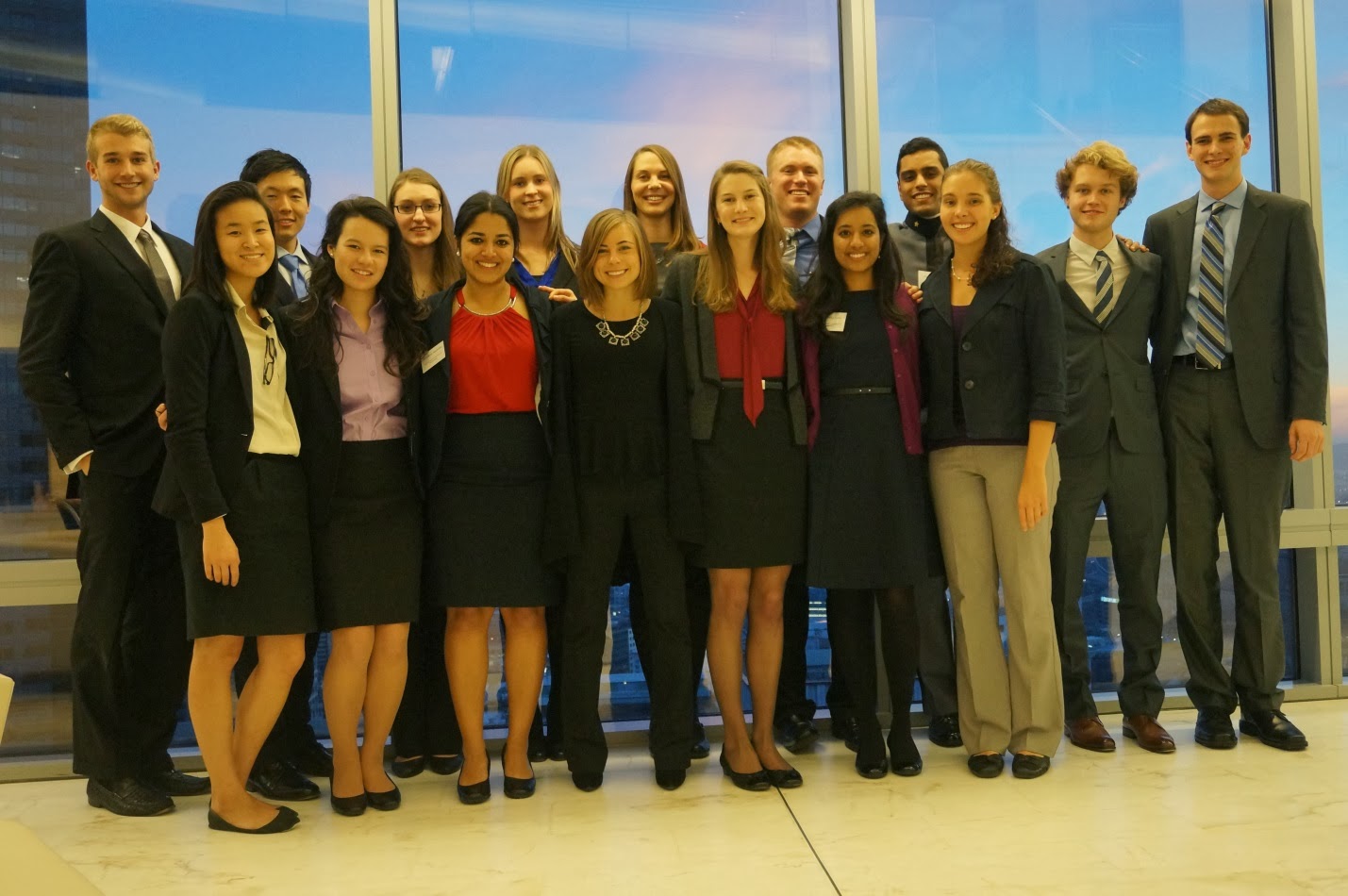
Interviewees/Finalists for District 14 (pictured below):
Steven Kyle Cook: Columbia
Harshini Jayaram: MIT
Priyanka Saha: MIT
Adriana Cherskov: Princeton
Patrick Tate: Montana State University
Gennie Gebhart: University of Washington
Mika Weinstein: University of Oregon
Britta Stime: Gonzaga
Ahmad Nasir: West Point
Kirsten Tilleman: Oregon State and UCSB
Narintohn Luangrath: Boston University
Mark Fischer: Northwestern
Alexander Sun: UCLA
Suzanna Marie Fritzberg: Yale (Winner)
Andrew Scott Lea: Harvard (Winner)

2013-2014 Rhodes District 14 Finalists


Mika Weinstein

District 14 Finalist


I arrived at K&L Gates about ten minutes early and introduced myself to other finalists while we waited in the lobby area. We mingled and talked until everyone arrived, including the interviewers. The receptionist collected our official transcripts and then we headed into another room for lunch. Again, we mingled while drinking some sparkling cider. The interviewer who was in my cluster impressed us by going around and speaking to each of our study interests just based on name tags. After another ten minutes or so, Rob Mitchell got everyone’s attention. He asked that each of us share our name, hometown, undergraduate degree program, and proposed area of study at Oxford. There were sixteen finalists and seven interviewers. 

After introductions, we sat down at three different tables with labeled name placards. We had five finalists and two interviewers at our table for the appetizer course.  The interviewers asked us who had come the farthest, but after that, were relatively quiet. I asked them many questions and was surprised that none of the other candidates took the opportunity to be assertive. Honestly, it was pretty awkward. A few others did jump in at different points but I was the main driver of conversation. I must have been stuck with a shy table because we could hear lively conversation at the other tables. I mainly asked about Oxford and which colleges they attended and we talked a bit about President Obama’s visit to Seattle. 

The main course was very different. We had three interviewers at our table and we naturally split up into conversations with two or three people in each. I mainly spoke with the interviewer next to me and another finalist, Stephen. We talked about ultra-marathons and other extreme sports for a while. Somehow we got on the topic of sexual violence policy on college campuses. We talked about the lack of acknowledgement for gender dynamics in sexual violence which led to a conversation on the gender dynamics of shooting massacres in the US. After a bit of good conversation, the interviewer stopped us, explaining that she wasn’t supposed to talk about her politics, and returned the subject to sports. 

The dessert course was again a full table conversation with the last two interviewers. We talked about fishing, which led to a short aside about my stepfamily in Bhutan (one of them had been fishing in Bhutan). We talked about marathons and ultra-marathons again for a while as well. At some point we talked about the generational differences in defining historical moments (JFK’s shooting v 9/11) and how that continues to impact society. 

The entire mingling and lunch portion went from about noon to 2pm, and the first interview was at 2:30pm. At the end of lunch, they passed out a schedule of interview slots which had been randomly selected. I was slotted for the last interview, 2:30pm on Saturday. They gave us a tour of the floor, particularly the library where we were told to hang out and get to know one another, and the room where we would be interviewing. They also showed us the “waiting room” where we would be fetched from, which had a computer and desk in it. 

After about ten minutes of chatting in the library, most of us decided to head out and explore the area a little. Almost all of the finalists were from Seattle or the outlying area (and then one from Spokane, one from Eugene, one from Alaska, one from Montana, me from California, and maybe one or two others who were from somewhere else in Oregon or Washington – none from Idaho or Wyoming). We took a ride on a Ferris wheel and then headed back to the office because of the cold. Someone set up a google doc with all of our contact information so that we could communicate about dinner or other things. Generally the tone was very friendly, not competitive, and the camaraderie only increased from there. One girl, who had competed as a finalist in Southern California the year before, said that we were much friendlier and closer than the SoCal group. 

That evening, after resting and seeing my dad for a few hours, I went to dinner with three other finalists. One of them had set up GroupMe, a group texting service, so that we could easily contact everyone. From there we met up with another finalist for a few drinks at a nearby bar. We exchanged stories about the level of preparation we had received and how the interviews had gone. All four of them had interviewed that day. The girls from OSU/UCSB and Gonzaga/Queens University Belfast (both of them had already started grad school) received almost no institutional support. Each of them had found one former finalist/scholar who mentored them and did one mock interview, but it was relatively informal. The girl from MIT had a bit more formal of a mock interview, but all agreed that their mocks were nothing like the real interview. 

On the other hand, the guy from Northwestern had been in contact with their Office of Fellowships since he was called in his sophomore year. They gave him explicit advice on what to do over the next few years (ex. Learn another language or two, be sure to run his marathon before the interview, not after), which he wasn’t entirely comfortable with. He graduated in June, but the school paid to fly him back from Colombia for six days of intensive mock interviews (he couldn’t even remember how many he did – at least five). They then flew him to San Francisco for his Marshall interview and Seattle for the Rhodes. 

The guy from Northwestern felt that his interview had gone as well as it could have, and it was obvious he was prepared for it. Two of the girls did not feel like they had performed their best, and were surprised at the more personal questions, which they had not been prepared for. Through later conversations with some of the other finalists, it was obvious that the level of preparation played a huge role in how they felt the interview went. I remember seeing Suzanna (the girl from Yale who won) reviewing what looked like very well organized and extensive notes before her interview.
I was asleep by 11:30 and got a good 9 hours of sleep. The next morning I went to Pike Place Market with my dad and then got ready and reviewed my notes again before heading over to the office. They were running a little behind schedule but before long I was in the holding room, reviewing notes, practicing responses out loud, and meditating a little. The chairman came to get me and pointed to my water glass when I arrived. One of them acknowledged how hard it was go last and noted that because of my last name, I was probably used to it. We laughed and generally I felt very relaxed going in. I’ll list the questions here, and while I can’t remember the exact order, it was something like this:

  •  One of your recommenders described you as being “idealistic but not naïve” and “realistic but not pessimistic”. Can you provide another binary like this to describe yourself?
  •  A long intro but basically – thinking about issues like bioenergy, how do you decide between food and the environment? 
  •  Who is someone you admire in your field? 
  •  What are one or two of the biggest problems facing the US food system and what are a few policy ideas to address them?
  •  What do you think about consolidating food nutrition labels to just proteins, fats, and carbs? 
  •   Why are you interested in those particular Master degrees?
  •  What do you like to do? What do you read and listen to in your free time? 
  •  What’s your ideal career path? 
  •  Have you ever had to be hard on someone to get them to do something? 
  •  Would you support a tax on commuters into cities to subsidize public transportation?
  •  You talk about fasting in your personal statement. Is this something we should encourage more people to partake in?

These questions were not far off from the types of questions I was asked during my mock interviews, though I think in some cases the ones in my mock were actually better. There was no particular order in which different interviewers asked questions and one man asked the clear majority of questions, while some only asked one. Some of them I felt like I answered clearly and confidently, while a few caught me off guard (notably 9, 10). I did tell them that I needed a second to think for question 9. At some points (especially on the policy related questions) they interrupted me and asked a different question. Overall, I did feel like I smiled more and showed more of my interest/personality in the real interview than in my mocks, but it didn’t feel like a winning interview and I’m not entirely sure why.

At the end of my 20-25 minutes, the chair said that the time was up and asked if I wanted to share anything else. I thanked them all and then said something along the lines of: “I do want to share one more thing, because I think it provides some insight into who I am. I have spent a fair amount of time in prison over the last few years, because of my class and various workshops, and I’ll be TAing a class in a maximum security prison in the spring. The guys always love having us in, but often wonder what compels us to return and work with them. My theory is that there is something inherent to human nature that wants to connect with people who have had radically different life experiences from our own. Learning about how those connections revitalize me has been just as important as other parts of my education at Oregon.” I could tell from the “mmm”s and nodding that they were impressed and that it was the right note to end on. It might have been the strongest moment in my interview. 

When I came back out, everyone was waiting in the reception area. We chatted and played some trivia games while we waited. It took them a little more than 2 hours to deliberate. When they returned, everyone stood and they acknowledged how great the group was. After they announced the winners, they came around and shook everyone’s hands. Doug, one of the interviewers who had sat with me at the first course, told me that I was one of his strongest candidates. I told him how much I appreciated knowing that. We all left on friendly terms and agreed to stay in touch.


Wednesday, January 15, 2014

"Baby, baby!!": OB/GYN rotation in Fairbanks, Alaska

Last January, I submitted my preferences for all 3rd year clinical rotations. Recognizing the unique opportunity to see and spend an extended period of time in different parts of the beautiful northwest (on the medical school's dollar), I specified that I would love the opportunity to do one rotation in Alaska, and one in rural Wyoming or Montana.  Contrary to the usual rotation requests, I did not specify the time of year, which specialty I wanted to do in each location, or specific cities.  So, when I received my schedule in April and had been assigned to FAIRBANKS, Alaska (the northern most site) for OB/GYN in late summer (the best time of year) - to say I was thrilled would be an understatement!

I arrived in Fairbanks to an incredibly generous setup: TWO offices (one private one in the hospital, and one shared one in the clinic), my own O.R. locker, a very nice car to drive, and a beautiful condo all to myself situated directly on an incredible wildlife conservatory!  I took the first day there to unpack, and identify a new church "home away from home", and within 48 hours of arriving already had a dinner invite!
Hey!  It's the small things!  :)
The conservatory which served as the grounds for my nightly jog.
Once at the clinic, I was immediately put to work training in OB visits in the clinic, labor and delivery in the hospital, and gynecological exams and surgical fixes for all ages and relevant health concerns.

Sample Day:
        6:30 - Rounding at the hospital on patients who had delivered, were in labor, or had had surgery in the days previous.
        7:00 - C-Section at the hospital!!
        8:00 - At the clinic, reading through the charts of patients I would see that day
        8:30 - Start seeing clinic patients!  Prenatal care, gynecological concerns, "annual exams", etc.
        3:00 - Done seeing patients in clinic, catch up on charting, eat lunch/dinner
        4:00 - Back to the hospital!  PUSHHHHHH!!!  Laboring any patient in the hospital in labor.
        7:30 - To bed!  .....maybe......yeah right.......
        (11 pm) - Ring, ring, ring!  "Hi, Analiesse?  We have a G3P2 at 9cm, about to start pushing.  Please hurry!
        (2 a.m.) - Ring, ring, ring!  "Hi, Analiesse?  There is a woman with a miscarriage in the E.R., who needs a D&C.  How soon can you be here?"
        (5:30 a.m.)  - Beep, beep, beep!  (Alarm clock.)  You have GOT to be kidding me!!  :-)

My Responsibilities/Abilities:
One of the most common questions I receive is with regards to how much I am able to actually do.  "I mean, YOU don't actually do the surgeries, yourself....RIGHT??!"  Umm, no.  Well, kinda.  But, no.  You can breathe.  ;-)
  •  Clinic visits: I typically saw a patient and did their entire history (asked all the usual questions..."how long has it been going on for?"  "what have you tried to make it better?"  "are you bleeding/cramping/swelling/vomiting/crying/screaming, etc.") and did the physical exam (listen to the heart, see what parts I am supposed to see....all except for the breasts and vagina)....then I would come out of the patient room and give report to my supervising physician, he would ask me a million questions, and I would give a treatment plan....and then we would go back in together, and I dis the remainder of the exam with the physician watching and directing as necessary.
  •  Patient in labor:  The extent of my involvement with laboring patients varied significantly, depending on how long I had been on the rotation, which physician I was working with, and the comfort of the patient.  By the end of the rotation, I would typically labor the patient all the way through on my own ("PUUUUUSH!!!  Almost there!  Okay, deep breath.  PUUUUUUSH!!!"), and call the physician in right as the infant started to crown (top of the baby's head is visible to everyone in the room).  I was able to "catch" (deliver with out assistance; the doctor supervising from over my shoulder) on multiple occasions, but really, this aspect varied the most.  And please remember, the patient and child were never in additional danger by my presence; the physician was always within running distance, should I have needed the backup.  :)  In fact, in many cases, the patient received BETTER care because they have one more set of hands and eyes, and often a more *present* person (I usually had fewer cases to concern myself with, than the physicians, so would spend more time with each patient).
  •  Gynecological surgery: It was expected that I would prepare for surgery extensively the night before: know the anatomy I would see like the back of my hand, understand possible complications, and why the procedure was being performed.  Then, depending on the surgery and my level of experience on the type of case, I would act as either the 1st or 2nd assist to the surgeon.  Assisting typically involved retracting (holding things in place), suctioning, and some basic suturing.  
    • Now, I LOVE surgery, don't get me wrong.  But honestly?  This was my least favorite aspect of this rotation...because of the extent of "pimping".  "Pimping" is when you are verbally tested over anything and everything, at the drop of a hat.  Of course, in the O.R., when one is scrubbed (sterile) and hands are in a patient, there is no quick Google search to be had.  It's either in your brain, or it isn't!  And there is always a room full of people (anesthesiologist, scrub nurse, circulating nurse, surgeon, assistant surgeon, and whoever else) to hear you hit or miss.  I would quite frequently freeze up, even if I knew the material well, and it did not take long for me to dread walking into the O.R. for what became hours of an oral exam.  (It really wasn't that bad.  But it's a mind game!)

Biggest Mistakes:
    (Kind of) Comical:  I was doing a pelvic exam on a woman who had had a total hysterectomy, and was concerned about her risk for cancer.  Not feeling a uterus (since it's obviously been removed) or anything suggestive of a cancerous mass, and caught up in the process of the exam, I stated (well meaningly!), "Well, there's not much here!!"  The woman jumped.  "WHAT DO YOU MEAN, 'there's not much here' ?!?!?!?!"   .......oops.....I mean....(sigh)......

   Serious: So, I write on this so as to acknowledge that, yeah....this is hard stuff....and to my fellow medical students:  it's not just you!  (Gulp.)  I was assisting on a mastectomy, and in closing the patient at the end of the surgery, I was suturing from one side of the wound, and the surgeon was suturing from the other side - with the intention to meet in the middle.  And, well.....somehow my suture needle found its way into (gulp...) the hand (gulp...) of the surgeon.  (GULP!)  Needle stick!  This means HIV and Hepatitis testing for the surgeon for a while to come.  NOT GOOD.  Not good at all.  And I can now hang my head in massive shame....  and someone, please remind me to remove this post come time to apply for residency.  ;-)

 Best Memories: 
   1. One of my best friends, Kelci, flew up to visit me!  We had an incredible time watching chic flicks, soaking in hot springs, dancing under northern lights at 2 a.m., whitewater rafting, ATVing, singing karaoke, hiking, and just generally sharing our hearts with one another.  Along the way, we also met a couple other fabulous individuals, and the adventures had together as a group stand among my all time favorite memories.
2. My father also flew up to visit while I was there.  Together, we adventured around Mt. Denali/McKinley and talked careers, Faith, and "boys" (he loves receiving updates and instilling his Daddy wisdom).
Poorly attempted "Selfie".
3. I integrated rather quickly into a phenomenal "church family", and was adopted by a family within that church while there.  I love that family dearly, and hold memory of the time spent together close to my heart.
"Sushi Party" at the Ekblad's!  We rocked that sushi!!
What God Taught Me:  Choose the Brighter Lens

Lens 1:  These rotations are by NO MEANS "easy"!  I was constantly messing up, walking on egg shells, and working insanely tortuous hours.  These are all things through which any medical student could really use the arms of family, the support of friends, or the ears of co-med students as we reassure one another: "it's not just you; and while that's bad....you'll never guess how I screwed up!!"  But in Fairbanks, as the only medical student for over 1,000 miles, and objectively evaluated by nearly every individual I encountered....through the shake downs and scoldings, I often found myself asking, "Am I really just that terrible a student??"

Add on top of that, while gone, I missed my brother's 21st birthday, my sister's 27th birthday, and my two nephews' (who are the WORLD to me) 8th and 2nd birthdays.  Additionally, my grandfather (whom I love dearly, and lived with my first year of medical school) was diagnosed with terminal cancer mere days before I boarded the plane!!

"Inadequacy" and "loneliness" were certainly fitting descriptors.

-----Now, completely erase that image from your head-----

Lens 2:  The medical school is essentially paying me (as in, my loans are no greater than the medical students staying in Seattle, and my flight, car, and condo were covered) to live up an extraordinary adventure!  I got to spend six weeks in one of the most beautiful corners of the world, was warmly embraced by the community, made incredible new friends, and got to actually *do* the medicine I have been dreaming of for years!!!  Does it get any better???!
~~~~~~~~~~~

Both lens 1 and lens 2 are completely accurate.  But which of these I choose to view life by...in Alaska, and in all life's chapters....was and is entirely up to me.  And the same for you!  You can CHOOSE to live your life with reflection upon the good and the hope!  Chronic joy is one condition by which we can choose to live life.  Happiness...not always.  But joy....yes.  :-)


Philippians 4:8   Finally, brothers, whatever is true, whatever is noble, whatever is right, whatever is pure, whatever is lovely, whatever is admirable--if anything is excellent or praiseworthy--think about such things.

Matthew 11:28   "Come to me, all you who are weary and burdened, and I will give you rest."

Psalm 118:24   This is the day the Lord has made; let us rejoice and be glad in it!!

Sunday, January 12, 2014

A Reflection on Haiti: 4 Years Post-Earthquake

~~~~~~THIS IS A DRAFT~~~~~~~~

Please do not conclude too much from what is below.  In fact, you should really just push the "back" button now.  ;)  I write something every year on the anniversary of the earthquake, and I wanted to make sure I wrote down and published my thoughts tonight (1/12/14).  But, my heart is heavy, and my mind conflicted.  I will come back to this when I can see through the clouds a bit better.  Please excuse the clumsiness below for now.  :)


My Dearly Beloved Haiti-

You break my heart.  But I love you.  Just the sound of your name invokes a great sorrow, remorse, frustration.  But I love you.  You continually break my heart yet again and again.  But I can't stop loving you.

Nearly every week, someone will proudly tell me of their upcoming work in Haiti, or of their friend's work in Haiti, or of their neighbor's uncle's ex-girlfriend's work in Haiti.  There is always an excitement in their voice.  A seeking for my mutual excitement and approval.  But do they not see??

Haiti, you are broken.  And this great influx of naive aid only sits further on your weakened knees.  Their hearts are beautiful!  Please, do not blame them!!  They are just as excited to see your children's smiling faces as I once was.  They walk away with the same thrill and wonderment I once did.  Please, understand they want nothing but the very, very best for you!!  Truly!

After the earthquake, you needed help.  You were crippled, and you so desperately needed people to reach in and do what they could to save every life within your borders.  But, as the aid multiplied, lingered, and remained blind to your nature - it has debilitated your ability to help yourself.  Just as in the way a small chick helped out of its shell has not the strength to support its own life, you no longer have the ability to help yourself from your knees

I know things were hard for you before; I know you hurt.  But, at least you had functioning businesses.  While painful, you walked on your own two weak legs. But now, the number of Haitian owned clinics within Port au Prince can be counted on one hand, as the others have been run out of by the well-intentioned "free clinics".  What we see is "helping" the patients in front of us; while what you know is the trade of long-term care familiar with the culture within which it lies, to a short sighted "flashy" care rot with misunderstandings.

That doctor, he truly meant the very best!  He saw a hurting child with hydrocephalus, who was certain to live a life of difficulty if someone did not do something!  So, the doctor stepped in....


Oh dear Haiti, you give me renewal.  You give me joy.  You give me an understanding of beauty.  And so I love you.

But oh, how I hurt for you.

-Your Beloved

Monday, September 30, 2013

"Doctor, am I crazy?!": Psychiatry rotation at Harborview


Eager for the first day!


I will never forget my very first patient.  It was the first patient, of the first day, of my first rotation.  My team was composed of an attending physician, a resident physician, another medical student, and myself, and we sat in a small conference room, with our patient seated directly across from us in what we term a "patient interview".  I watched on as the resident spoke with the patient about her most recent symptoms.  "Have you had any thoughts of wanting to harm yourself?"  "How are you sleeping?"  "Are you hearing things that others might not be hearing?"  The meeting seemed to be going relatively uneventfully, and I found myself relating with the patient, able to understand her frustrations at being kept in the hospital against her will.  I was just starting to let my mind wander in the midst of a seemingly uneventful encounter, when the resident asked the patient, "you seem distracted; is everything okay?"

"Yeah." the patient responded

"You seem like you aren't really paying attention to what I am saying anymore.  Can you tell me why?"

The patient's face stiffened, and eyes widened.  "Well, quite frankly, I don't appreciate you flirting with me right now!"

Hiding her surprise, the resident responded, "Would it help if I told you that I am not flirting with you?"

"No.  I know you're flirting with me, and I don't appreciate it!!"

With that, the patient rose from her chair, and stormed out of the room.  The other team members and I exchanged wide eyed glances, and tried to contain our snickers.  "WELCOME to Psychiatry!" chimed my attending physician.

From there, every day seemed to be filled with something incredibly exciting and entertaining - both from a medical standpoint, and from a purely "are you serious?!?!" standpoint.  The medical students would convene in our workroom at the start and end of every day, and exchange the bits of excitement we felt we morally and legally could (identifying details kept confidential).

The Harborview Psychiatry medical student workroom.  Most days Mt. Rainier could be clearly visualized out the window.

But as the drama of in-patient Psychiatric care at Harborview unfolded, I began to see something more, beyond the obscure and entertaining.

The psychiatry clinical rotation at Harborview is set up such that I worked with the same attending physician throughout my time there, and followed my physician's nine patients throughout their stay in the hospital.  I was assigned to follow two of the nine patients in depth, and when one of my patients was discharged, I would be assigned another, so that at any one time I was providing direct, in-depth care for two individuals (doing all pertinent research, obtaining medical records, calling consults, talking at length 1-on-1 with each patient after our group interviews), and following the other seven patients.

In spending significant amounts of time with just a small number of patients, and following the same patients from their admission to their discharge, I came to intimately know each individual.  With each passing day, each delving conversation, and each hurdle overcome, I came to know these individuals beneath the "crazy" the rest of the world had labeled them with - and that at times, they had come to label themselves with.  I came to understand these people as just that - people!

This was none more apparent than when I would have the opportunity to see a patient admitted with severe psychosis - where socially acceptable behavior was not possible, and the words from their mouth made little sense - and would watch on as the medications we prescribed had a chance to take effect, and the patient given a chance to find stability from their illness once again.  When the same individual who came in cursing and spitting, exclaiming that they were God and had all the powers of the universe, came to be a relaxed gentleman, rightfully frustrated with his illness and grateful for the chance at stability we were offering.  Or, when the same individual who came in after a serious suicide attempt and had to be restrained for repeated further attempts, came to the point he could share his hurting and broken story, and find hope in the life that could be. 

In coming to know some of the darkest and pain-filled lives, I began to see each as God's child whom he loves, and found myself in turn feeling legitimate love for even the most publicly outcast and despised.  That same person I had once stared at on the street corner, termed as "crazy", and wondered how they had let their life come to what it was - I came to recognize as an ill and hurting mind, desperate for someone to see their soul for its true worth.  I found myself questioning to what ends I would go if I were to see one of my homeless patients, after discharge, again roaming the streets of Seattle speaking to themselves for having mistaken the seeming stability they felt while on the meds, as healing that would sustain (and so stopping their meds).  And my heart hurt at the possibility of a relapse, for having seen what health and well-being meant for each individual.  I even came to see some of the "murderers" under my care as ill individuals with chemical and physical imbalances they could not control, who wanted nothing more than a way "out" - an out they could not find on their own.

In one scenario, having heard the patient's heart-wrenching life story, I found myself thinking, "How does a person go through this and not break?!"  And then I reminded myself...that's right, mentally, they have broken.  And then I would find myself wondering, "How does a person go through all this and continue to live?!"  And then I reminded myself.....that's right, they are here for having tried to end their life.

I was given the extraordinary gift of staring into the darkest of places alongside hurting and broken hearts.  I was allowed to see illness and brokenness like I had never seen it before.  And I was trusted and leaned on, purely for the white coat I wore.  I was unworthy to share such secrets and to take part in such life-giving transformations, but it was handed to me all the same.

The piece of their lives my patients shared with me were gifts more precious than gold, as they allowed me to see humanity and hurting in a new light. For each story is one to tell, each soul a unique creation, and each heart a broken heart.


Galations 3:28    There is neither Jew nor Greek, there is neither slave nor free, there is no male and female, for you are all one in Christ Jesus. 


Malachi 2:10  "Have we not all one Father? Hath not one God created us? Why do we deal treacherously every man against his brother by profaning the covenant of our fathers?" 


1 Corinthians 13: 1-3  If I speak in the tongues of men and of angels, but have not love, I am a noisy gong or a clanging cymbal. And if I have prophetic powers, and understand all mysteries and all knowledge, and if I have all faith, so as to remove mountains, but have not love, I am nothing. If I give away all I have, and if I deliver up my body to be burned, but have not love, I gain nothing.


***I take the faith my patients place in me extremely seriously.  No individual patient story has been shared, and every event referred to happened on multiple occasions across the wards - disabling any potential personalization by patients or their families.  I have paid careful attention to HIPAA and other regulations, as well as to how I believe my patients and sponsoring physicians would feel if they were to come across this.  If you have ANY concerns regarding this piece or pieces to come, please bring them to my attention as soon as you are able, in person, by phone, by Facebook message, or by e-mail.  Thank you!  isher@u.washington.edu